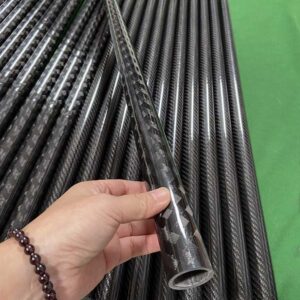
In modern billiards, small differences in material, structure, and consistency can completely change how a cue performs. For this reason, cue brands, OEM manufacturers, and distributors should treat the carbon fiber tube behind the shaft as a key performance component, not just a basic part. It directly affects feel, stiffness, durability, deflection, and long-term product consistency.
Over the past few years, carbon fiber cue shafts have moved from a premium upgrade to a mainstream option in many performance cue lines. Compared with traditional wood shafts, carbon fiber offers better dimensional stability, a higher stiffness-to-weight ratio, and stronger resistance to humidity and temperature changes. As a result, brands selling into different markets can reduce warping issues and keep product quality more consistent across batches.
For B2B buyers, the question is no longer whether carbon fiber can work for cue shafts. Instead, the real challenge is how to specify, source, test, and scale the right carbon fiber tube for each product line.
Key Advantages Over Traditional Wood Shafts
Wood has a long history in cue manufacturing, and many players still enjoy its traditional feel. However, wood is a natural material, which means every piece can vary in grain, density, straightness, and long-term stability.
Carbon fiber tubes provide a more engineered solution. Manufacturers can control the fiber grade, resin system, layup direction, wall thickness, and taper profile during production. Because of this, they can tune the shaft for stiffness, weight, balance, and impact response.
For cue brands, this creates several practical advantages. First, carbon fiber shafts offer more stable dimensions in different climates. In addition, they reduce the risk of warping during storage or shipping. Moreover, they provide better batch-to-batch consistency, which supports OEM production.
At the same time, carbon fiber also gives brands more freedom in surface finish, branding, and performance positioning. This helps companies produce repeatable cue models while still offering different product levels.
Start With Clear Performance Targets
A successful carbon fiber cue shaft begins with clear product positioning. Before discussing production with a tube manufacturer, the brand should define the target player, market level, and playing style.
For example, one shaft model may target professional players who want very low deflection and a firm hit. In contrast, another model may serve all-round players who prefer a smoother and more forgiving feel. Entry-level carbon fiber shafts may focus more on durability and consistency rather than extreme performance tuning.
Important design targets include shaft length, tip diameter, target weight, balance point, stiffness level, deflection performance, joint system, ferrule design, and surface finish. Once the brand defines these targets, the supplier can turn a performance idea into a repeatable production specification.
In other words, clear specifications help buyers avoid unnecessary prototype problems later.
Important Technical Parameters
A carbon fiber cue shaft is not just a simple round tube. In fact, small changes in geometry and layup can significantly affect the final playing experience.
The main technical parameters include outer diameter, inner diameter, wall thickness, taper design, layup orientation, fiber grade, resin system, joint-end reinforcement, tip-end reinforcement, and surface finish.
Manufacturers can make the wall thickness constant, stepped, or gradually adjusted depending on the required stiffness and weight distribution. Meanwhile, the layup may include 0°, ±45°, and 90° fiber directions. Each direction serves a different purpose. Axial fibers help with stiffness and straightness, while ±45° layers improve torsional control. In addition, 90° hoop layers improve crush resistance around the joint and tip areas.
For OEM projects, buyers should provide a technical drawing with diameter points at different shaft positions. If the design is still under development, the buyer can start with performance goals and work with the supplier through prototype testing.
Roll-Wrapped Carbon Fiber Tubes
Roll wrapping is one of the most common processes for high-quality carbon fiber cue shafts. In this process, technicians cut carbon fiber prepreg sheets into designed patterns and wrap them around a precision mandrel.
The team can adjust the layup layer by layer. Therefore, the manufacturer can control stiffness, flex, torsion, and weight with greater accuracy. After wrapping, technicians usually compress the tube with shrink tape or a pressure sleeve, then cure it in an oven or autoclave. After curing, they remove the mandrel and finish the outer surface to the required dimensions.
For cue shafts, many manufacturers choose roll wrapping because it offers strong design flexibility. In particular, it suits custom taper profiles and performance-driven layups. As a result, brands can fine-tune the product through prototype iterations before moving into larger production.
Filament-Wound and Pultruded Tubes
Filament winding is another method for composite tubes. Unlike roll wrapping, this process uses continuous carbon fiber tows wound under controlled tension around a rotating mandrel. By changing the winding angle, the manufacturer can adjust hoop strength and axial stiffness.
This process delivers high repeatability and efficiency for certain tube designs. However, it offers less flexibility than roll wrapping for complex cue shaft tapers. For this reason, filament winding works better when batch consistency and hoop strength matter more than complex taper customization.
Pultrusion works differently. It pulls continuous fibers through resin and a heated die to create a constant cross-section profile. Although pultruded carbon tubes work well for straight structural tubes, they usually do not suit high-performance cue shafts that need a carefully tuned taper and feel. Instead, brands may use them for extensions, handles, or simple structural components.
Fiber Grade and Layup Design
The performance of a carbon fiber cue shaft depends heavily on the fiber grade and layup structure. Generally, brands use standard modulus carbon fiber as a balanced option because it offers good stiffness, toughness, and cost control.
Intermediate modulus fiber can provide higher stiffness and lower deflection while still maintaining reasonable impact resistance. On the other hand, high modulus fiber can make the shaft very stiff, but engineers must use it carefully. If the shaft becomes too stiff, players may feel a harsh or brittle response during play.
The layup structure matters just as much as the fiber grade. Manufacturers commonly use UD carbon fiber to provide axial stiffness. In addition, woven carbon fiber, such as 3K twill, can improve appearance and add torsional stability. ±45° layers help resist twisting, while 90° layers support crush resistance and dimensional control.
A good supplier should understand how these layers work together. Rather than simply adding more carbon fiber, the supplier should help the brand find the right balance of stiffness, feedback, control, and durability.
Resin System and Impact Resistance
Most performance cue shafts use epoxy resin systems. However, not all epoxy systems perform the same way. The resin affects impact resistance, interlaminar strength, surface quality, and long-term stability.
Because cue shafts experience repeated impact and bending, the resin system should offer good toughness and strong bonding between layers. In addition, a higher glass transition temperature can help the shaft remain stable in warmer environments or during international shipping.
For larger OEM programs, buyers should ask for basic resin information, including mechanical properties, Tg data, and curing conditions. This matters especially when the shaft will go through coating, painting, bonding, or assembly after tube production.
Taper Profile and Player Feel
The taper profile has a major influence on how a shaft feels in play. Even small changes in diameter can affect stiffness, balance, bridge comfort, and player feedback.
A pro taper usually keeps the front section almost parallel for a longer distance. Many competitive players prefer this because it feels more familiar during bridge movement. In contrast, a conical taper increases diameter more progressively from tip to joint and may create a firmer hit.
Some brands choose hybrid tapers to create a unique feel. For example, they may combine a stable front section with a stronger rear section to balance control and power. Manufacturers can create this structure through mandrel design, outer diameter grinding, or both.
For production consistency, the drawing should define the diameter at several reference points along the shaft. Otherwise, the supplier may only control the tip and joint dimensions, which cannot support a repeatable cue shaft program.
Wall Thickness, Weight, and Balance
Wall thickness directly affects stiffness, vibration, and final shaft weight. A uniform wall thickness simplifies manufacturing and inspection. However, it may limit the designer’s ability to fine-tune balance and flex.
Variable wall thickness gives the designer more control. As a result, it can help shift weight, adjust stiffness in different sections, and create a more refined hit. Some designs may also use internal inserts or core materials to adjust sound, feel, or balance.
Because carbon fiber shafts are often lighter than wood shafts, brands should consider the complete cue system, not just the shaft. For example, the final cue weight may need adjustment through butt weight bolts, joint material, ferrule design, or internal components.
Surface Finish and Branding Options
Performance matters most, but appearance also affects how customers perceive the product. Therefore, buyers should consider surface finish early in the design stage.
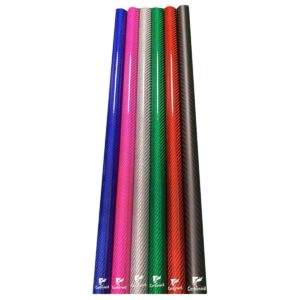
Common surface finishes include raw sanded carbon, matte clear coat, satin finish, semi-gloss finish, high-gloss clear coat, painted finish, and textured finish.
Matte finishes reduce glare and provide a smooth stroke feel. Meanwhile, glossy finishes create a premium appearance and highlight the carbon weave. Some brands prefer a visible 3K twill cosmetic layer, while others choose a cleaner black finish with subtle branding.
Brands can laser mark, pad print, or place logos under clear coat depending on the design. However, when choosing a cosmetic layer, the buyer should confirm that it does not weaken or interfere with the structural layup.
What Buyers Should Prepare Before Sourcing
When approaching a carbon fiber tube supplier, buyers should prepare as much technical information as possible. This helps the supplier understand the target product more quickly and reduces unnecessary prototype revisions.
Useful information includes 2D drawings, 3D models, shaft length, tip diameter, joint-end diameter, diameter points along the taper, target weight, wall thickness range, preferred stiffness, surface finish, joint system, tip and ferrule requirements, expected quantity, prototype needs, and packaging requirements.
If the buyer does not yet have a complete drawing, the supplier can still help develop one. For example, the project can start from current wood shaft samples, competitor references, or player feedback. After that, the supplier can translate those references into a practical carbon fiber tube design.
How to Evaluate a Carbon Fiber Cue Tube Supplier
Not every carbon fiber tube manufacturer suits cue shaft production. Generic tube suppliers may produce good industrial tubes. However, cue shafts require tighter control of straightness, weight, taper, surface finish, and feel.
When evaluating suppliers, buyers should look at their experience with cue shafts or similar precision tubes. In addition, they should check whether the supplier can support custom layup development, material traceability, stable fiber sourcing, process control, dimensional inspection, batch records, prototype support, and production scaling.
A reliable supplier should discuss both manufacturing details and performance goals. In other words, the supplier should understand not only price and MOQ, but also how the tube affects the final playing experience.
Quality Control and Testing
Cue players can notice small differences in shaft feel. For this reason, manufacturers need strict quality control.
Typical inspection items include outer diameter at multiple shaft positions, straightness, weight, surface finish, wall thickness, visual defects, joint-end dimensions, and tip-end condition.
For new projects, teams may need additional testing. For example, three-point or four-point bending tests can help compare stiffness between different versions. Torsion tests can check twist resistance. In addition, impact tests help verify the strength around the tip and joint sections.
Environmental testing can also help confirm stability under temperature and humidity changes. Finally, each production batch should include clear identification, material certificates, cure records, and inspection reports. This helps brands manage warranty issues and maintain traceability.
Lead Time and MOQ Planning
Carbon fiber cue shafts require multiple production steps, including material preparation, layup, curing, mandrel removal, grinding, finishing, inspection, and packaging. Because of this, buyers should plan enough time for development and production.
Prototype development may take several weeks, especially when the design is new. After that, pilot runs may require additional time for testing and feedback. Larger production orders depend on quantity, tooling, material availability, and factory workload.
Setup time, material batch size, tooling, and production efficiency usually affect MOQ. For custom shaft designs, suppliers normally require a higher MOQ than they do for standard tubes. However, brands can reduce complexity by using one base tube design for several cue models, then differentiating the final products through joints, ferrules, tips, finishes, and branding.
Packaging and Handling
Carbon fiber shafts are lightweight, but manufacturers still need to protect them carefully during shipping. Although they are strong in use, transport can still cause impact damage, bending, scratches, or damage at the cut ends.
Good packaging usually includes individual plastic sleeves or soft wrapping, end caps, foam protection, non-abrasive bundling, inner cartons, strong outer cartons, and clear labels.
In the factory or warehouse, workers should store shafts horizontally on padded racks. In addition, operators should avoid dropping, dragging, or clamping the shafts without protection. Otherwise, small cosmetic or structural damage may appear before the shafts even reach final assembly.
Downstream Assembly Considerations
Carbon fiber shafts require different handling compared with wood. Therefore, operators should use composite-suitable tools and methods for cutting, drilling, bonding, and joint installation.
Sharp cutting tools and controlled feed rates help reduce fraying and delamination. At the same time, adhesives should match the resin system and surface finish. Production teams should test tip, ferrule, and insert bonding before mass production.
After final assembly, brands should recheck straightness, weight, finish, and joint fit. This ensures that the finished cue shaft meets the same quality standard as the tube itself.
Common Sourcing Mistakes
Several problems often appear in carbon fiber cue shaft projects. The first common mistake is giving vague requirements, such as “make it stiffer” or “similar to this model” without measurable targets. This often leads to repeated prototype revisions.
Another mistake is underestimating development time. Tuning feel, sound, deflection, and balance may require several rounds of testing.
Some buyers also focus only on price and ignore downstream assembly needs. As a result, a tube that looks acceptable may still create problems during joint installation, coating, or ferrule bonding.
The most successful programs usually treat the supplier as a technical partner, not just a vendor. By sharing player feedback, warranty data, and sales performance, brands can help the supplier improve the product over time.
Carbon Fiber Cue Tubes vs. Traditional Wood Shafts
| Attribute | Carbon Fiber Cue Tubes / Shafts | Traditional Wood Shafts |
|---|---|---|
| Stiffness-to-weight ratio | High, suitable for low-deflection designs | Moderate, depends on wood quality |
| Dimensional stability | Strong resistance to humidity and temperature changes | More sensitive to climate |
| Batch consistency | Manufacturers can control consistency through engineered materials and process | Natural wood variation affects consistency |
| Design flexibility | Engineers can adjust layup, wall thickness, taper, and finish | Wood species and taper mainly limit design options |
| Durability | Good fatigue resistance and stable performance | Warping and long-term use can affect performance |
| Appearance options | Brands can choose carbon weave, matte, gloss, painted, or branded finishes | Brands mainly use grain, stains, wraps, and inlays |
| Production scalability | Suitable for repeat OEM production | Raw wood selection and consistency limit scalability |
| Player feel | Modern, stable, low-maintenance | Traditional, familiar feedback |
FAQ
Can a generic carbon fiber tube supplier make cue shafts?
It is possible, but it carries risk. Although generic tube suppliers may understand carbon fiber production, cue shafts require specific control of taper, straightness, stiffness, weight, and surface feel. Therefore, a supplier with cue shaft experience will usually reduce development time and avoid common defects.
Are carbon fiber shafts completely warp-proof?
Carbon fiber shafts are much more stable than wood. However, no material can avoid damage in every condition. Extreme heat, poor storage, or strong mechanical abuse can still affect the shaft.
Does a stiffer shaft always perform better?
No. Higher stiffness can reduce deflection. However, too much stiffness may create a harsh feel. Therefore, the best design depends on the target player, product level, and playing style.
How many prototype rounds are normally needed?
The number depends on how clear the original targets are. Some projects can reach confirmation after two or three versions. However, more performance-sensitive designs may need several rounds of testing before the brand approves the final layup.
Can one tube design be used for several cue models?
Yes. Many brands use one base shaft design and create different models through joint systems, ferrules, tips, surface finishes, and branding. As a result, this approach can reduce MOQ pressure and simplify supply chain management.
Next Step: Develop a Reliable Carbon Fiber Cue Shaft Program
For brands planning to launch or upgrade a carbon fiber cue line, the best starting point is a focused technical discussion with a supplier that understands cue applications.
Prepare your current shaft specifications, target performance, player feedback, expected quantity, and branding requirements. With this information, the supplier can help turn your idea into a clear tube specification, prototype plan, and scalable production process.
A well-designed carbon fiber cue tube does more than improve durability. More importantly, it gives your brand a repeatable product platform that can support future models, stable quality, and stronger market differentiation.